Decorative Elements Medicine Set: A Practical Guide to Smarter Design Choices
When you are looking for a way to elevate your visual projects without spending hours sketching from scratch, the Decorative Elements Medicine Set offers a surprisingly robust solution. It is not just a collection of images; it is a toolkit designed to bridge the gap between medical professionalism and creative flair. Whether you are designing packaging for a new health product, creating educational materials for a blog, or developing a brand identity for a clinic, having high-quality assets at your fingertips can make the difference between a generic look and a polished, trustworthy presentation.
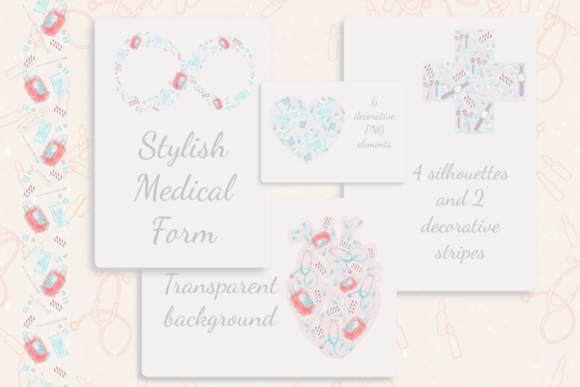
The core value of this set lies in its versatility and precision. You receive six distinct decorative elements provided as PNG files on transparent backgrounds. This detail is often overlooked by beginners who might settle for standard JPEGs with white boxes around them, but transparency is non-negotiable for professional composition. Furthermore, the package includes 30 different design variations across five unique medical forms, available in both PNG and JPEG formats. At 300 DPI, these assets are ready for high-resolution printing, ensuring that your posters, stickers, or fabric prints remain crisp and clear.
Why Beginners Often Struggle with Medical Illustrations
Many creators assume that finding suitable medical imagery requires expensive stock subscriptions or advanced illustration skills. While those are valid options, they often come with hidden pitfalls. The most common mistake involves using low-resolution graphics that appear pixelated when scaled up for large formats like wallpapers or posters. Another frequent error is ignoring the file format requirements. Using a JPG with a solid background limits your ability to blend the design seamlessly into complex layouts, forcing you to spend time manually removing backgrounds—a process that rarely yields perfect results.
If you have ever tried to place a medical icon onto a colorful background only to see a jagged white halo around it, you understand the frustration. This issue directly impacts the perceived quality of your work. In the healthcare and wellness sectors, visual clarity communicates competence. Blurry or poorly integrated elements can inadvertently signal a lack of attention to detail, which is a critical risk for freelancers, small business owners, and educators trying to build trust with their audience.
How to Avoid Common Pitfalls in Asset Selection
To ensure your designs meet professional standards, you need to evaluate your resources carefully before downloading or purchasing any asset pack. When considering the Decorative Elements Medicine Set, focus on the technical specifications first. Verify that the resolution is indeed 300 DPI if you plan to print. Many free or cheap online resources offer web-optimized images (72 DPI) that look fine on a screen but turn out muddy when printed on packaging or postcards. By checking the DPI beforehand, you save yourself from costly reprints and wasted time.
Another area where users often stumble is the limitation of editing capabilities. Some sets lock their elements in specific layers or use proprietary formats that require specialized software. This collection avoids that trap by offering standard PNG and JPEG files. Because the backgrounds are transparent, you can mix and match any pattern with individual elements instantly in tools like Canva, Adobe Photoshop, or even simpler graphic editors. This flexibility allows you to create custom compositions without needing a degree in graphic design.
- Check File Compatibility: Ensure your design software supports PNG transparency. Most modern tools do, but older versions might struggle.
- Verify Resolution Needs: If your project involves fabric or large banners, confirm the 300 DPI specification is present in the download details.
- Test the Blend: Before committing to a full project, drag one element onto a complex background to see how well it integrates.
Maximizing Value Across Diverse Applications
The true power of this collection emerges when you apply it beyond simple icons. The five types of medical forms included in the set are designed to be modular. You can take a single element and combine it with different patterns to create a cohesive theme for a magazine article, a website banner, or a series of social media posts. For entrepreneurs, this means you can maintain a consistent brand voice across all touchpoints—from the sticker on your product box to the logo on your website—without hiring multiple designers.
For educators and bloggers, the ease of editing is a game-changer. You can quickly create illustrations for health tips, infographics about nutrition, or promotional materials for workshops. Instead of struggling to find clipart that matches your color scheme, you can import these transparent PNGs and adjust their size and position to fit your narrative perfectly. This efficiency allows you to focus on the content rather than the mechanics of image placement.
It is also important to consider the aesthetic consistency. Randomly mixing clipart from different sources often results in a disjointed look where some elements look hand-drawn while others look like photos. Since all elements in this set share a unified style, your final composition will look intentional and professionally curated. This uniformity is essential for logos and branding, where every pixel contributes to the overall message of reliability and care.
Strategic Planning for Your Design Projects
Before you start assembling your layout, take a moment to define the end goal. Are you creating a digital asset for a blog, or are you preparing a physical product? If the answer is physical, such as wallpaper or fabric, the 300 DPI resolution becomes your primary constraint. If the project is digital-only, you still benefit from the high resolution, as it ensures your images look sharp on retina displays and high-definition monitors.
Do not underestimate the importance of the transparent background feature. It is the key that unlocks creativity. Without it, you are limited to rectangular placements that look stiff. With transparency, you can arrange elements organically, overlapping shapes to create depth and interest. This capability is particularly useful for marketers who want to create eye-catching postcards or stickers that stand out on a crowded shelf or in a digital feed.
By understanding these nuances, you move from simply "using" an asset to truly leveraging it. The Decorative Elements Medicine Set is more than a download; it is a foundation for building high-quality visuals. Whether you are a hobbyist experimenting with scrapbooking or a professional agency managing a client's rebrand, the ability to mix, match, and edit these elements freely provides the freedom to innovate. Just remember to check your resolution needs and embrace the transparency to avoid the common mistakes that plague amateur designs.
In conclusion, making informed decisions about your design resources pays off in the quality of your output. By selecting a set that offers high resolution, versatile formats, and transparent backgrounds, you ensure that your projects communicate clearly and effectively. Take the time to explore the possibilities within this collection, and you will find that creating beautiful, functional designs is far more accessible than you might have thought.